Stake Mines Game – Official Mines Game at Stake
Stake Mines is a grid-based casino game that challenges players to uncover gems while avoiding hidden mines on a customizable board. The game takes inspiration from the classic Minesweeper but adds real money betting and multipliers that can reach impressive heights. Each tile you reveal either increases your potential payout or ends the round if you hit a mine.
We found that Stake Mines stands out because it lets players control their own risk level by choosing how many mines appear on the grid, making it suitable for both cautious players and those seeking higher rewards. This flexibility means you can adjust the difficulty based on your comfort level and betting strategy. The game combines simple mechanics with genuine tension as each click could multiply your winnings or end your round.

In this guide, we’ll walk you through everything you need to know about playing Stake Mines in India. You’ll learn how the game mechanics work, what strategies can improve your results, and how to avoid common mistakes that cost players money. We’ll also compare Mines to other instant games and explain what makes it appealing to different types of players.

There are no available offers for your location 😢 Use VPN with another location if you would like to bet 😼
Stake Mines – Game Overview For Indian Players
Stake Mines combines elements of the classic Minesweeper computer game with casino-style betting, creating a grid-based experience where players reveal tiles to earn multipliers while avoiding hidden mines. The game offers customizable difficulty levels and potential payouts that can reach up to 5,000,000 times the original bet.
What The Mines Game Is And How It Differs From Slots
Stake Mines presents players with a grid where they select tiles one by one. Each tile either contains a gem that increases the multiplier or a mine that ends the game. Players can cash out at any time before hitting a mine to collect their current winnings.
The key difference from slots is the player-controlled pacing. We don’t spin and wait for results. Instead, we choose which tiles to reveal and when to stop playing. This creates a different experience from traditional slot games where outcomes happen automatically.
| Feature | Stake Mines | Traditional Slots |
|---|---|---|
| Pace Control | Player decides when to reveal tiles | Automatic spin results |
| Game Duration | Varies based on player choices | Fixed per spin |
| Risk Management | Cash out anytime | Must complete each spin |
| Betting Structure | Single bet with escalating multiplier | Per-spin wagering |
Players set the number of mines before starting, which directly affects the potential payout and risk level. More mines mean higher multipliers but greater chances of losing.
Why Mines-Style Games Are Popular In India
Mines-style games appeal to Indian players because they feel interactive and engaging. The format resembles popular puzzle games many Indians already know. This familiarity makes the game easy to understand for new casino players.
The betting flexibility suits different budgets. Players can start with small bets and adjust the difficulty by changing mine counts. The ability to cash out early provides a sense of control that appeals to cautious players.
The game runs quickly on mobile devices without requiring high-speed internet. This matters in areas where connection quality varies. The simple graphics load fast compared to video slots with complex animations.
We also see that the strategic element attracts players who want more involvement than pure chance games offer. The choice of when to stop creates moments of decision that feel meaningful.
Skill Perception Vs Random Outcomes
Players often believe they can develop strategies to predict safe tiles or identify patterns in Stake Mines. This perception of skill creates engagement even though each tile selection is a random event.
The grid layout gives an illusion of choice. In reality, the mine positions are predetermined and random. No tile is safer than another when starting fresh. The feeling of making smart decisions keeps players interested, but the math remains unchanged.
Some players develop betting systems or tile selection patterns. These approaches don’t change the odds. Each game round operates independently with fixed probabilities based on the mine count selected.
The true skill in Mines involves bankroll management and knowing when to cash out. Players who set win targets and stick to budgets perform better over time. The game rewards discipline more than tile selection strategies.
How Stake Mines Game Works
Stake Mines operates on a simple grid system where players select tiles to reveal gems while avoiding hidden mines that end the round. The multiplier increases with each successful tile selection, and players decide when to cash out or risk another pick.
Grid Layout And Hidden Mine Logic
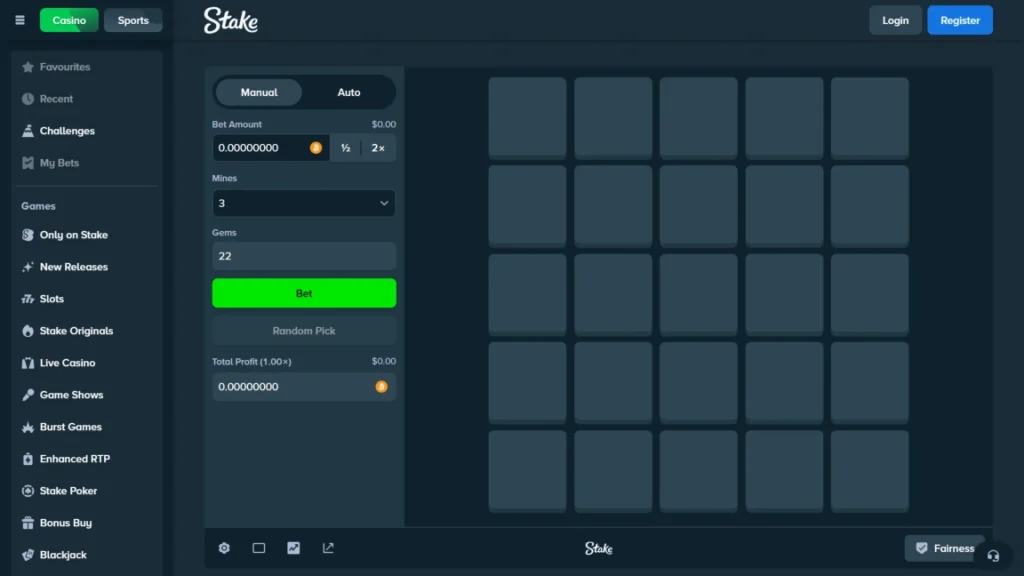
The game uses a 5×5 grid with 25 tiles total. Before starting, we choose how many mines to place on the grid, typically ranging from 1 to 24 mines.
The mines are randomly distributed across the grid at the start of each round. We cannot see where they are hidden until we click on a tile. The game uses provably fair technology to ensure the mine placement is random and cannot be manipulated.
Mine Distribution Options:
| Number of Mines | Risk Level | Available Tiles to Pick |
|---|---|---|
| 1 mine | Very Low | 24 safe tiles |
| 5 mines | Low | 20 safe tiles |
| 10 mines | Medium | 15 safe tiles |
| 20 mines | High | 5 safe tiles |
| 24 mines | Extreme | 1 safe tile |
More mines mean higher risk but also higher multiplier increases per successful pick.
Picking Tiles And Increasing Multipliers
Each time we click a tile and reveal a gem, our multiplier increases. The multiplier growth depends on how many mines we selected at the start.
With more mines on the grid, each successful pick adds a larger multiplier boost. For example, with 3 mines, our second gem might multiply our bet by 1.18x. With 20 mines, that same second gem could multiply it by 6x or more.
We can continue picking tiles as long as we avoid mines. The potential payout shown on screen updates with each successful selection. The maximum multiplier can reach up to 5,000,000x our original bet in extreme scenarios with many mines and consecutive successful picks.
What Ends A Round And Locks A Win
A round ends in two ways: clicking on a mine or choosing to cash out. If we hit a mine, we lose the entire bet for that round. The game reveals where all mines were hidden after this happens.
When we click the cash out button, we collect our current multiplier amount. The round ends immediately and our winnings are added to our balance. We can cash out after revealing just one gem or wait until we’ve uncovered many tiles for a higher payout.
Risk Levels And Game Customisation
Stake Mines lets players control their risk by adjusting mine counts on the grid, which directly changes payout potential and difficulty. The game offers complete flexibility in how aggressive or conservative you want your approach to be.
Choosing The Number Of Mines
We can select anywhere from 1 to 24 mines on the playing field before each round starts. This choice creates the foundation for our entire gameplay experience.
Starting with fewer mines makes the grid safer but reduces the multiplier growth rate. A single mine on the board gives us the lowest risk but also the smallest potential rewards. As we increase the mine count, each successful tile selection becomes more valuable.
The grid typically uses a 5×5 format with 25 total tiles. Setting 3 mines gives us a moderate challenge suitable for steady gameplay. Moving to 10 mines creates a significantly harder game where more than one-third of tiles are dangerous.
Most players find their comfort zone between 3 and 7 mines. This range provides enough risk to generate meaningful multipliers without making the game feel like pure chance. We need to match our mine selection to both our bankroll size and risk tolerance.
How Difficulty Affects Payout Growth
The number of mines we choose changes how quickly multipliers increase with each safe tile we reveal. More mines mean faster multiplier growth per click.
| Mines | Risk Level | Multiplier Growth |
|---|---|---|
| 1-3 | Low | Slow, steady increases |
| 4-8 | Medium | Moderate acceleration |
| 9-15 | High | Rapid growth per tile |
| 16-24 | Extreme | Explosive but dangerous |
With 3 mines active, revealing 5 safe tiles might give us a 1.5x multiplier. The same 5 tiles with 10 mines could push us past 3x or higher. Each additional mine compounds the payout potential because we’re navigating through more danger.
The RTP stays at 99% regardless of our mine selection. What changes is the volatility and how wins are distributed across our sessions.
Low-Risk Vs High-Risk Play Styles
Low-risk players typically use 1-5 mines and cash out after revealing 3-6 safe tiles. This approach focuses on consistent small wins that build bankroll gradually. We might win more frequently but individual payouts stay modest.
High-risk strategies involve 10+ mines and attempting to clear large portions of the grid. These sessions produce bigger multipliers but fail more often. A single mistake ends the round immediately.
We recommend low-risk play for bankroll preservation and longer sessions. It works well when we have limited funds or want to extend our playing time. High-risk approaches suit players with larger bankrolls who can absorb frequent losses while chasing significant wins.
Medium-risk strategies using 5-8 mines offer the best balance for most players. We get reasonable multiplier growth without the extreme variance that comes from maximum mine counts.
Starting A Round In Stake Mines
Before we can reveal tiles and hunt for gems, we need to configure the round parameters and decide how we’ll approach the game. The setup phase determines our risk level and potential rewards.
Setting The Stake Amount
We begin each round by selecting our bet amount. The game allows us to enter any value within the minimum and maximum limits set by the platform. Most players can start with amounts as low as $0.10 or even $0 for practice rounds.
The stake amount directly affects our potential winnings. Higher bets mean larger payouts when we successfully reveal safe tiles, but they also mean bigger losses if we hit a mine. We should consider our bankroll size when choosing a stake amount.
| Bet Size | Best For | Risk Level |
|---|---|---|
| $0 | Practice and learning | None |
| $0.10-$1 | Beginners | Low |
| $1-$10 | Regular players | Medium |
| $10+ | Experienced players | High |
We can adjust our stake between rounds based on our performance. Many players start small to understand the game mechanics before increasing their bet sizes.
Manual Play Vs Instant Decisions
We have two main ways to play each round. In manual mode, we click individual tiles one at a time and can cash out whenever we want. This gives us full control over when to stop and collect our winnings.
The instant play option reveals multiple tiles at once based on our preset conditions. We set the number of tiles to uncover, and the game automatically reveals them. This mode works faster but removes our ability to cash out between reveals.
Manual play suits players who want to assess risk after each tile. We can evaluate the remaining safe spaces and decide if continuing is worth the risk. Instant play appeals to those who prefer quick rounds without constant decision-making.
When Players Usually Cash Out
The cash-out decision depends on the multiplier growth and remaining tiles. After revealing each safe tile, our multiplier increases, and we can claim our current winnings at any time.
Many players cash out after doubling or tripling their initial stake. Conservative players might exit after revealing just 2-3 tiles on a board with multiple mines. Aggressive players push further, aiming for 5x or 10x multipliers.
The number of mines on the board affects cash-out timing. With fewer mines, we can safely reveal more tiles before the risk becomes too high. With many mines, even revealing a few tiles carries significant danger, prompting earlier cash-outs.
Stake Mines On Mobile Devices (India)
Indian players can access Stake Mines on smartphones and tablets with full functionality. The mobile version maintains the same grid-based gameplay and multiplier features while adapting controls for touchscreen devices.
Playing Mines On Android Smartphones
We can play Stake Mines on Android devices through the mobile browser without downloading a separate app. The game loads directly on Chrome, Firefox, or any modern browser. Indian players simply visit the Stake website and log in to access the Mines game instantly.
The mobile interface adjusts automatically to different screen sizes. Android users with devices running version 8.0 or higher can expect smooth gameplay. The grid layout scales appropriately whether playing on a 5-inch or 7-inch screen.
| Device Requirement | Specification |
|---|---|
| Android Version | 8.0 or higher |
| Browser | Chrome, Firefox, Safari |
| Internet Connection | 3G minimum (4G recommended) |
| Screen Size | 5 inches or larger recommended |
Touch Controls And Responsiveness
The game uses tap controls to select tiles on the grid. We simply touch any square to reveal what’s underneath. The interface responds immediately to taps with visual feedback showing which tile we selected.
Players can adjust their bet and mine count using touch-friendly buttons and sliders. The cashout button stays easily accessible at the bottom of the screen. All controls are sized appropriately for finger taps without accidental clicks.
The grid remains stable during gameplay with no lag between tapping and tile reveals. We found the touch response works consistently across different connection speeds.
Performance On Low-End Mobile Devices
Stake Mines runs efficiently on budget Android phones with limited processing power. The game requires minimal resources since it uses simple graphics and basic animations. We tested gameplay on devices with 2GB RAM and found stable performance.
Lower-end phones may experience slightly longer initial loading times. Once the game starts, the actual gameplay remains smooth. Indian players using devices from 2020 or newer should have no issues running Stake Mines.
The game automatically adjusts graphics quality based on device capabilities. Battery consumption stays moderate during extended play sessions.
Real Money Gameplay In Stake Mines
When playing Stake Mines with real money, the game processes bets and payouts instantly through your account balance. Each decision to reveal a tile or cash out directly affects your funds in real time.
Minimum And Maximum Bet Behaviour
Stake Mines allows players to customize their bet amounts before each round starts. The minimum bet typically starts at $0.10, making the game accessible for casual players who want to test strategies without risking large amounts.
The maximum bet limit varies based on your account status and the platform’s current settings. Most players can wager up to several hundred dollars per round. We recommend checking the bet input field before starting, as these limits can change.
You must set your bet amount before revealing any tiles. Once you start clicking tiles, you cannot adjust your wager for that round. The bet multiplier increases with each safe tile you reveal, but your base stake remains locked in.
Balance Updates After Each Round
Your account balance changes immediately when you cash out or hit a mine. If you reveal safe tiles and choose to cash out, the winnings appear in your balance within seconds. There is no waiting period for funds to process.
When you hit a mine, your bet amount is deducted instantly. The game shows your updated balance at the top of the screen after each round ends. This transparency helps you track your spending and wins accurately.
We noticed that successful rounds add both your original bet and the profit to your balance. For example, a $1 bet with a 3x multiplier returns $3 total, not $3 profit plus your original stake.
Fast Rounds And Bankroll Impact
Stake Mines rounds finish quickly, often in under 30 seconds. This speed means you can play many rounds in a short time, which directly impacts how fast your bankroll changes.
Players who make quick decisions might complete 20-30 rounds in just 10 minutes. At $1 per round, that equals $20-$30 in bets during a brief session. The rapid pace requires careful bankroll management to avoid depleting your funds too quickly.
We suggest setting a session budget before playing. The fast gameplay can make it easy to lose track of total spending across multiple rounds.
Mines Game Strategy Thinking
The game relies on chance, but understanding probability, managing your bankroll, and recognizing the limits of any strategy helps you make better decisions at the table.
Probability Awareness And Common Patterns
The number of mines you select directly affects your odds of hitting a safe tile. With fewer mines on the board, you have better chances of revealing diamonds, but the multipliers stay smaller. More mines mean higher payouts but dramatically increased risk.
Understanding the Math
| Mines on Board | First Tile Safety | Risk Level |
|---|---|---|
| 3 mines | 88% safe | Low |
| 10 mines | 60% safe | Medium |
| 20 mines | 20% safe | High |
Each successful reveal changes the probability for the next click. If you start with 3 mines on a 25-tile grid and click one safe tile, your next click has a 3/24 chance of hitting a mine instead of 3/25. The odds get worse with each safe tile you uncover.
We don’t see reliable patterns in where mines appear because each game uses random placement. The previous game’s mine locations tell us nothing about the current round.
Managing Losses Over Short Sessions
Setting a fixed budget before playing protects us from chasing losses. We should decide our total spending limit and stick to it regardless of outcomes.
Cash-out timing matters more than the number of tiles we reveal. Taking smaller wins consistently works better than pushing for maximum multipliers. If we double our bet, we can cash out and start fresh.
Basic Session Management
- Set a loss limit (example: $50 per session)
- Define win goals (example: cash out at 50% profit)
- Take breaks after big losses or wins
- Reduce bet size after three consecutive losses
We track our spending in real-time rather than trying to remember our total. Most players underestimate how quickly small bets add up during extended play.
Why No Strategy Guarantees Profit
The house edge exists on every round we play. No betting pattern or tile selection method changes the mathematical advantage the game holds. We face negative expected value over time.
Strategies that claim to predict mine locations or guarantee wins ignore how random number generation works. Each round starts fresh with independent probability. Past results don’t influence future tile placement.
We should treat any approach as a way to manage our gameplay, not as a path to consistent profits. The game is designed for entertainment with the understanding that the house maintains an edge on every bet we place.
Visual Simplicity And User Experience
Stake Mines delivers a streamlined gaming experience through its minimal interface and fast gameplay mechanics. The design removes unnecessary elements to keep players focused on the grid and their strategy.
Clean Interface And Distraction-Free Design
The game presents a simple grid layout without cluttered menus or flashy animations. We see a 5×5 board as the main focus, with essential controls placed clearly at the bottom or side of the screen. The color scheme uses dark backgrounds with bright gems and clear mine indicators.
Players can view their current bet, number of mines selected, and potential multiplier without searching through multiple screens. The customization options appear before each round starts, letting us adjust risk level by choosing how many mines to place on the grid.
| Interface Element | Purpose |
|---|---|
| Grid Display | Shows tiles to click |
| Bet Controls | Set wager amount |
| Mine Counter | Select difficulty level |
| Cashout Button | Collect current winnings |
| Multiplier Display | Track potential payout |
The mobile version maintains this clean approach. All buttons and grid tiles are sized appropriately for touchscreens without making the interface feel cramped.
Speed-Focused Gameplay Flow
Each round in Stake Mines takes seconds to complete. We place our bet, select the number of mines, and start clicking tiles immediately. There are no waiting periods between rounds or forced animations that slow down the pace.
The instant cashout feature lets us collect winnings at any point during a round. One click on the cashout button ends the game and credits our account. This quick-action format suits players who want to complete multiple rounds in a short session.
Game results appear immediately when we hit a mine. The board reveals all mine locations, shows our result, and resets for the next round. We can adjust settings and start again within a few seconds.
Why Mines Appeals To Quick-Play Users
The game fits well into short breaks or mobile gaming sessions. We can complete five to ten rounds in the time it takes to play one hand of poker or wait for a slots bonus feature.
The straightforward rules require no learning curve. New players understand the concept within their first round without reading extensive instructions. This accessibility makes Mines attractive for casual gaming sessions.
Players control their session length completely. We decide whether to play one quick round or continue for an extended period. The lack of bonus rounds or special features means we never feel locked into longer gameplay than intended.
Stake Mines Vs Other Instant Games
Mines differs from other popular instant games through its grid-based, decision-driven format where players control each step, while games like Crash and Aviator use time-based mechanics that force quick reactions and automatic outcomes.
Differences Between Mines And Crash Games
The core difference lies in how players interact with each game. In Mines, we select tiles on a grid and choose when to cash out after each safe reveal. Crash games like Aviator display a multiplier that increases automatically until it crashes at a random point.
Mines gives us complete control over pacing. We can take several minutes analyzing the grid before making our next move. Crash games eliminate this option by forcing us to decide within seconds as the multiplier climbs.
| Feature | Mines | Crash Games |
|---|---|---|
| Control | Full control over each move | Must react to automatic multiplier |
| Pacing | Play at your own speed | Fast-paced, time-limited |
| Risk Selection | Choose mine count before starting | Fixed risk progression |
| Strategy Depth | Grid analysis and pattern consideration | Timing and cashout prediction |
The provably fair system works differently too. Mines locks in mine positions before we start, while Crash games use a predetermined crash point that reveals only after the round ends.
Decision-Based Vs Time-Based Mechanics
Mines requires active decision-making for every single action we take. We pick individual tiles, evaluate the remaining safe spaces, and decide whether to continue or cash out based on our assessment. This creates a strategic experience where skill and analysis play a role.
Time-based games remove this control element. In Crash, Aviator, or similar games, the multiplier increases automatically regardless of our actions. Our only choice is when to cash out before the inevitable crash occurs.
This mechanical difference affects how we manage bankroll. Mines lets us set loss limits by choosing safer mine counts and cashing out after small gains. Time-based games force us into their rhythm, creating pressure to cash out quickly or risk losing everything in seconds.
The mental engagement differs significantly. Mines keeps us actively involved throughout each round, while Crash games create tension through passive observation and sudden reactions.
Which Game Type Suits Different Players
Strategic players who enjoy calculated risks prefer Mines. The ability to adjust mine counts from 1 to 24 provides precise control over volatility and potential returns. We can start conservative with few mines and gradually increase risk as we build confidence.
Players seeking quick adrenaline rushes gravitate toward Crash games. These games deliver rapid results with minimal decision points. A single round completes in seconds rather than minutes.
Mines works best for:
- Players who want strategic depth
- Those who prefer slower, thoughtful gameplay
- People managing strict bankrolls
- Users who enjoy customizable risk levels
Crash games suit:
- Players wanting instant action
- Those comfortable with high volatility
- People who prefer passive observation
- Users seeking social multiplayer experiences
Beginners often find Mines easier to understand because each action has a clear outcome. Crash games require understanding multiplier curves and developing timing instincts that only come with experience. The 99% RTP in Mines also matches or exceeds most instant games, making it competitive from a mathematical standpoint.
Safety, Fairness, And Transparency
Stake Mines operates on cryptographic verification systems that let players check each round’s randomness, while players must also manage their own behavior and verify they’re using authentic platforms rather than fraudulent copies.
Randomisation And Provably Fair Concepts
The game uses a provably fair system that generates outcomes through cryptographic hashing before each round starts. We can verify every result by checking the server seed, client seed, and nonce that determine tile placement.
This verification process works independently of the casino. The system creates a hash of the server seed before we play, so Stake cannot change mine positions after we make our picks.
Key verification elements:
| Component | Purpose |
|---|---|
| Server Seed | Creates the initial random pattern (hashed before play) |
| Client Seed | Adds player-controlled randomness to the outcome |
| Nonce | Counts each bet to ensure unique results |
We can change our client seed at any time to influence the randomization. After each round, we access the verification tools to confirm the mine positions matched the original seeds. This transparency separates Stake Mines from traditional casino games where we must trust the house without proof.
Player Responsibility And Self-Control
No fairness system protects us from poor bankroll management or impulsive decisions. We need to set deposit limits and loss thresholds before starting any session.
The game’s quick pace can lead to rapid losses if we chase previous results. We should never increase bet sizes to recover losses, as each round operates independently with the same house edge.
Self-control practices:
- Set strict session budgets before playing
- Take mandatory breaks every 30 minutes
- Never play with money needed for essential expenses
- Avoid alcohol or playing when emotionally distressed
We must recognize that the game carries real financial risk despite its entertainment value. Setting win targets and walking away protects our bankroll better than any strategy.
Recognising Legitimate Platforms In India
Several fake sites copy Stake’s design to steal deposits and personal information. We verify we’re on the official Stake domain by checking the URL carefully and looking for proper SSL certification.
Legitimate platforms display their gaming licenses prominently and provide working customer support channels. We should test support response times before depositing significant amounts.
Authentication checklist:
- Verify the exact domain spelling matches official sources
- Confirm SSL certificate shows valid encryption
- Check for active social media presence with recent posts
- Test withdrawal processing with a small amount first
We avoid platforms that require excessive personal information beyond standard KYC requirements. Real Stake Mines includes the provably fair verification tools described earlier, while fake versions cannot provide working verification.
Common Player Mistakes In Mines
Players often fall into predictable patterns that reduce their chances of success in Mines. The most damaging errors involve pushing luck too far during hot streaks, escalating difficulty before building proper experience, and failing to set clear boundaries for playing sessions.
Overextending Winning Streaks
We see many players make their biggest losses right after their best wins. When you hit several successful rounds in a row, the temptation to keep clicking becomes strong. Your confidence grows with each safe tile, and cashing out feels like leaving money on the table.
The mathematics don’t change based on previous results. Each new tile you reveal carries the same risk regardless of how many games you’ve won before. A 5-mine grid doesn’t become safer because you just completed three perfect rounds.
Smart players set a target number of tiles before each round starts. If you planned to reveal 5 tiles, stick to that number even when everything goes well. The extra multiplier from one more tile rarely justifies the risk of losing everything you’ve accumulated.
Increasing Risk Too Quickly
We notice beginners often jump from low-mine games to high-mine configurations too fast. Starting with 3 mines, winning a few rounds, then immediately switching to 10 or 15 mines creates unnecessary losses. Your bankroll hasn’t grown enough to handle the increased variance.
Each mine you add to the grid dramatically changes the game dynamics. A 5-mine game offers steady, manageable wins. A 15-mine game creates wild swings where you’ll lose far more often than you win. Build your experience and budget gradually through the difficulty levels.
Ignoring Session Limits
We find that players without clear stopping points tend to give back all their winnings. Setting a loss limit protects your bankroll, but equally important is having a win goal. When you reach 50% or 100% profit for the session, consider ending on a high note.
Time limits work better than win-loss targets for some players. Decide you’ll play for 30 minutes or one hour, then walk away regardless of results. This prevents the “just one more round” mentality that erodes both profits and losses into bigger problems.
Frequently Asked Questions
Players often have questions about probability calculations, strategic approaches, and how different settings impact their gameplay experience in Stake Mines. The game’s customizable difficulty levels and risk settings create various scenarios that affect both winning chances and potential returns.
The probability of winning in Mines depends on the number of mines and the number of tiles you reveal. We calculate it by dividing the number of safe tiles by the total number of tiles remaining.
For example, on a 5×5 grid with 25 tiles and 3 mines, your first pick has a 22/25 (88%) chance of being safe. After revealing one safe tile, the next pick has a 21/24 chance of success. Each safe tile you reveal reduces both the total tiles and safe tiles remaining, which changes the probability for subsequent picks.
We recommend starting with a low number of mines to build your bankroll gradually. Many players use a consistent pattern of revealing 2-4 tiles before cashing out, which balances risk and reward.
The bankroll management strategy involves setting a fixed bet amount and never risking more than 1-5% of your total balance on a single game. Some players increase their mine count slightly after wins and decrease it after losses to manage risk.
Progressive reveal strategies work well for some players. They start with fewer mines and gradually increase difficulty as they accumulate profits. We find that cashing out early and often typically preserves bankroll better than attempting high-risk plays.
Beginners should start by playing with just 1-3 mines on the grid. This gives you a high success rate while you learn how the game works and how payouts increase with each safe tile revealed.
We suggest watching the multiplier increase as you reveal tiles to understand the risk-reward relationship. Each safe tile you uncover multiplies your potential winnings, but also increases the risk of hitting a mine on the next selection.
Practice identifying your comfort level with risk. The game shows your current profit after each tile, and you can cash out at any time. New players often benefit from setting a personal rule, like always cashing out after 3-5 safe tiles.
Low mine counts (1-5 mines) offer higher probability of success but smaller multiplier increases per tile. We can reveal more tiles safely, but the payout growth is gradual.
High mine counts (10+ mines) create much larger multipliers with each safe tile revealed. However, the probability of hitting a mine increases significantly, making it harder to reveal multiple tiles successfully.The choice between low and high mine counts depends on your playing style. Conservative players prefer low mines with consistent small wins, while aggressive players may choose high mines for larger potential payouts.
The difficulty level directly correlates with the multiplier applied to your bet. More mines on the grid mean higher multipliers for each safe tile you reveal.
With 3 mines, revealing 5 tiles might give you a 2x multiplier. With 10 mines, revealing the same 5 tiles could provide a 10x multiplier or higher. The game’s RTP of 99% stays consistent, but the volatility changes dramatically.
We see the most significant payout differences when comparing extreme difficulty settings. A maximum difficulty game can offer multipliers of 100x or more after just a few tiles, while minimum difficulty requires many more reveals to reach similar returns.
Stake offers a demo mode for Mines that lets players practice without risking real money. We can access this feature to learn the game mechanics and test different strategies.
The demo version functions identically to the real money version. It uses the same grid sizes, mine counts, and multiplier calculations. This allows us to develop a strategy and understand payout patterns before committing our bankroll.
We recommend spending time in demo mode to experiment with different mine counts and reveal patterns. This practice helps identify which risk levels match your comfort zone and playing style.